Two for one: A multi-instrument investigation into the molecule-rich JWST-MIRI spectrum of the two DF Tau disks
Stars are often born with siblings. The properties of these systems can have a large impact on the formation of any planets that may form around them. The DF Tau system has long been a target of interest for astronomers. Variability in the brightness of the system has been seen since the early 1900s but it wasn’t until the late 1980s that DF Tau was determined to be two equal-mass (around half the mass of the Sun) stars that orbit quite close together (the distance between Saturn and the Sun). High angular resolution observations from both ground- and space-based observatories previously pointed to the presence of only one disk in the system — a disk of gas and dust around DF Tau A — while the twin, DF Tau B, was diskless.
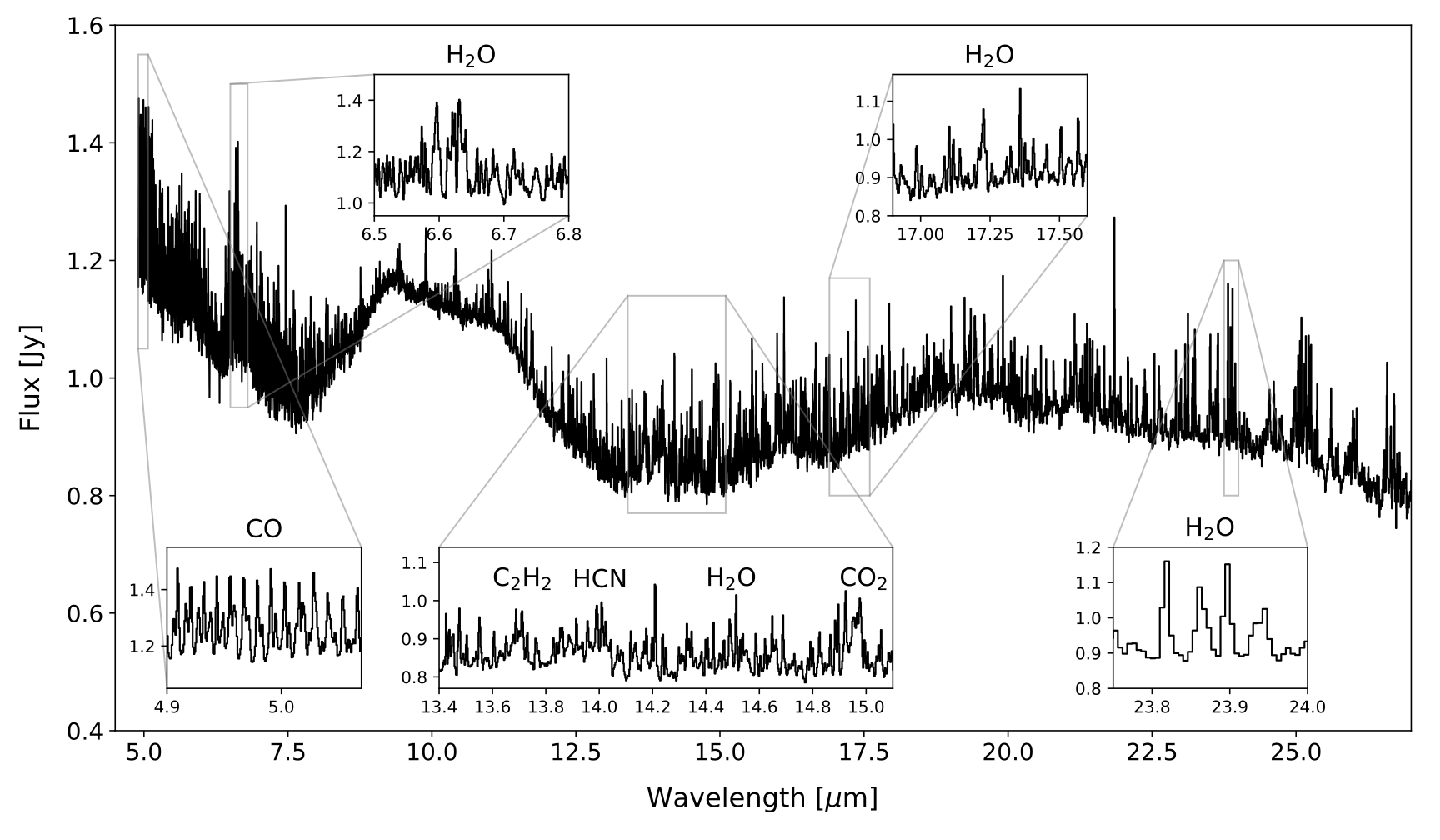
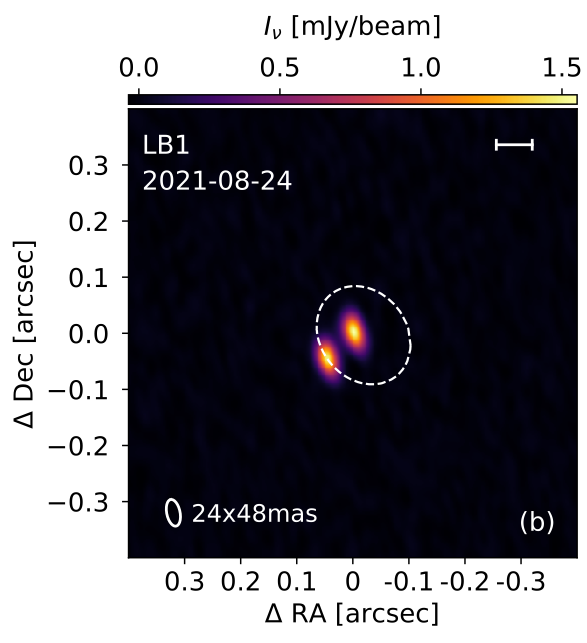
The DF Tau system was observed with JWST in February 2023 as part of the MINDS program. The resulting spectrum was extremely line-rich, full of emission from CO, C2H2, HCN, CO2, OH, and most prominently, a forest of water lines. Because JWST does not have the spatial resolution to separate DF Tau A and B, our team analyzed complementary ALMA, VLTI-GRAVITY, and IRTF-iSHELL data to gain as much information as possible to help interpret the rich JWST-MIRI spectrum. To our great surprise, the high angular resolution ALMA data showed two clear blobs of emission: DF Tau B also has a disk! Confirming with high accuracy astrometry from VLTI-GRAVITY, the second blob of dust continuum emission is confirmed to be co-moving with the expected orbit of DF Tau B. Based on the observations each disk is less than 3 au in radius, making them extremely compact. To reconcile all of the observations of DF Tau B, we suggest that this disk may host a small (~1 au) cavity.
In general, the properties of the gas in the DF Tau JWST spectrum are fairly normal, considering the extreme nature of the systems and the fact that the spectrum is the sum of two sources. Properties of the gas are similar to disks in isolated systems and based on the temperatures of the molecular emission, most of the emission is likely coming from the hot inner disk around DF Tau A. However, there is a cold (<200 K) water component in the spectrum that is coming from an area that is more extended than either disk alone. Therefore, this cold water component must be coming from both disks and may be coming from ice sublimation, potentially due to accretion variability, enhanced radial drift, or from the proposed cavity wall in DF Tau B. Higher angular resolution observations will be crucial to get the final picture of this enigmatic system.
This work was accepted to Astronomy & Astrophysics in June 2024 and the preprint is availablehere.
Top: The JWST-MIRI spectrum of DF Tau. Middle: The highest angular resolution ALMA continuum image. DF Tau A is at the center and DF Tau B is in the lower left. The orbit of DF Tau B, relative to DF Tau A, is shown in the dashed white line. Bottom: The 13.5 to 17 micron spectrum of DF Tau (black) compared to the total model (red). The molecular components that make up the spectrum are shown in the colors below.

 sierragrant.com