Accretion occurs when the gas in the protoplanetary disk falls onto the stellar surface. It is a critical mechanism that both heats the disk and clears it of material. Understanding how this accretion takes place and under what conditions has important implications for disk evolution. The mechanism is well-understood for low-mass stars. In these systems, the hot gas is funneled onto the star via the star’s magnetic field lines. However, more massive stars do not have strong magnetic fields and it is unknown how accretion occurs in these systems. These stars are called Herbig Ae/Bes. Stars that are even higher mass evolve so quickly that we cannot see how they accrete material because the stars are often so embedded in the molecular cloud that we cannot get a clear picture. Therefore, Herbig Ae/Be stars are the link to understanding how high-mass star formation proceeds.
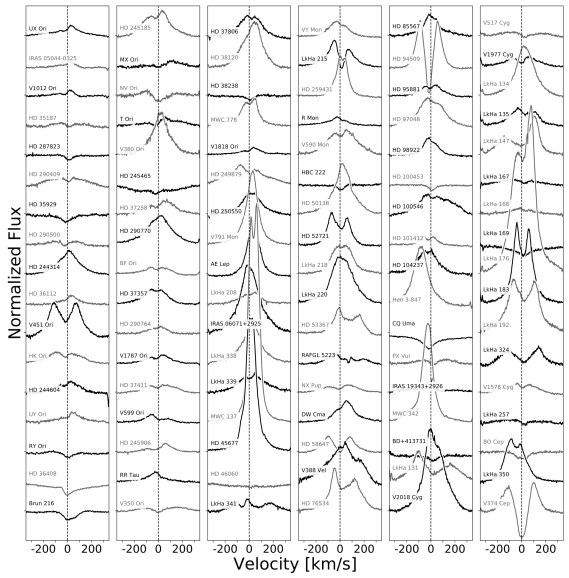
I have performed a survey of Herbig Ae/Be stars with the Lowell Discovery Telescope and Gemini South using the near-infrared spectrograph IGRINS. These observations include a Hydrogen line that is formed as material travels from the disk onto the star. I have used this data to look for accretion trends with stellar mass, age of the system, disk morphology (whether the disk has any gaps or cavities), and more. This work was published in the Astrophysical Journal in February 2022.
The accretion-tracing Brγ line profiles for the 102 Herbig Ae/Be stars that were observed with IGRINS. Figure from Grant et al. 2022.
 sierragrant.com