Understanding Protoplanetary Disk Evolution in the Lynds 1641 Star-forming Region
Many factors impact protoplanetary disk evolution, including the age of the system and the local environment. Younger systems often have more massive disks with a large population of small dust grains located in the upper layers of the disk atmosphere, giving the disk a flared shape. As the system evolves, the dust grains will settle to the disk midplane, collide, and grow into pebbles and then planetesimals and eventually, terrestrial planets or the cores of giant planets. If the disk is located in a dense stellar environment or near a massive star, the disk can be truncated, leading to small disks with less mass. I am interested in how disks evolve in general, searching for trends with age, location, stellar mass, etc.
The Lynds 1641 (L1641) region is located in the Orion Molecular Cloud A. L1641 is young (~1 Myr) and populous (with an estimated 1600 stars with disks and more evolved systems). This region extends along a filament south of the Orion Nebula Cluster (ONC), such that most of the region is far enough from the massive stars in the ONC that it does not show signs of being photoevaporated from the outside. In Grant et al. 2018, we analyzed far-infrared photometry of disks in this region from the Herschel Space Observatory and found that despite their young ages, the disks in L1641 already showed signs of dust evolution. My coauthors and I recently were awarded time with the Atacama Large Millimeter Array (ALMA) to study L1641 at radio wavelengths that trace the cold dust in these disks. Our results were published in the Astrophysical Journal in June 2021. I gave a talk on our results at the Five Years After HL Tau: a new era in planet formation conference and the talk is available here.
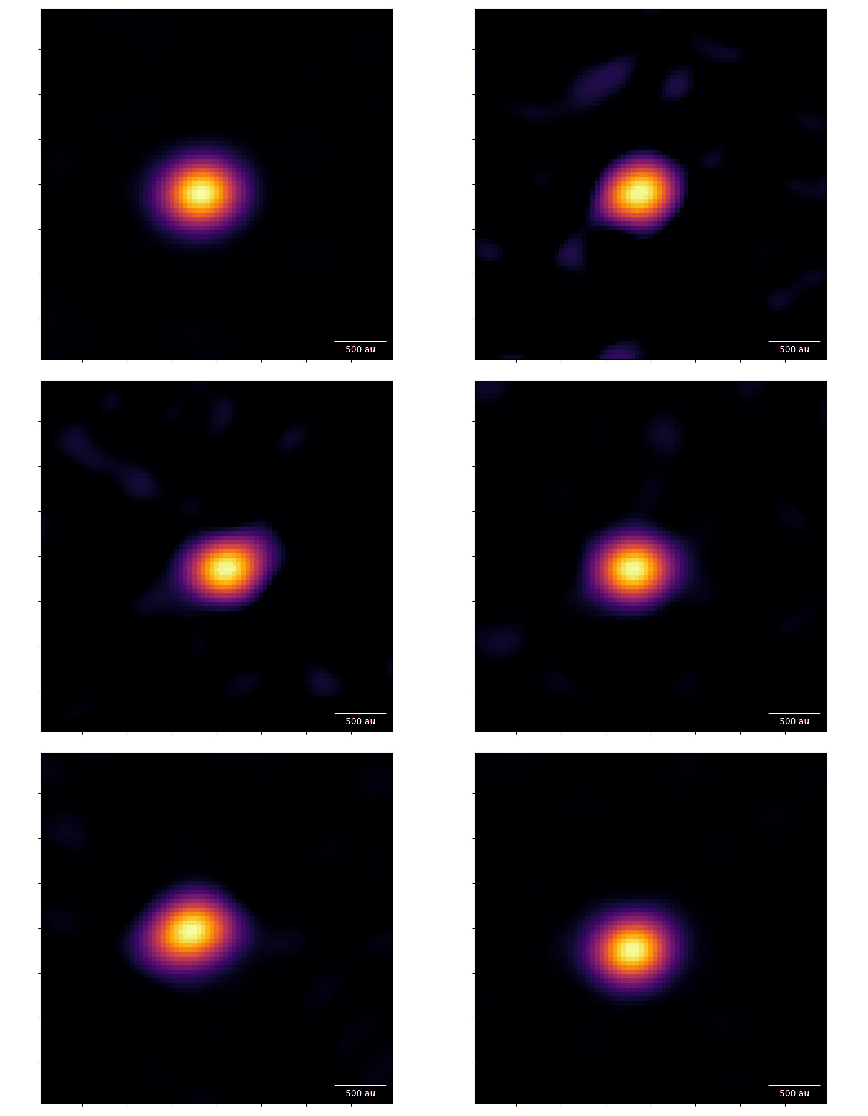
Here is a subset of the ALMA data in our Lynds 1641 sample. These are continuum images at 1.33 mm which trace the cold dust in the disks.
 sierragrant.com