From water-rich disks around Sun-like stars to carbon-rich disks around very low-mass stars and brown dwarfs
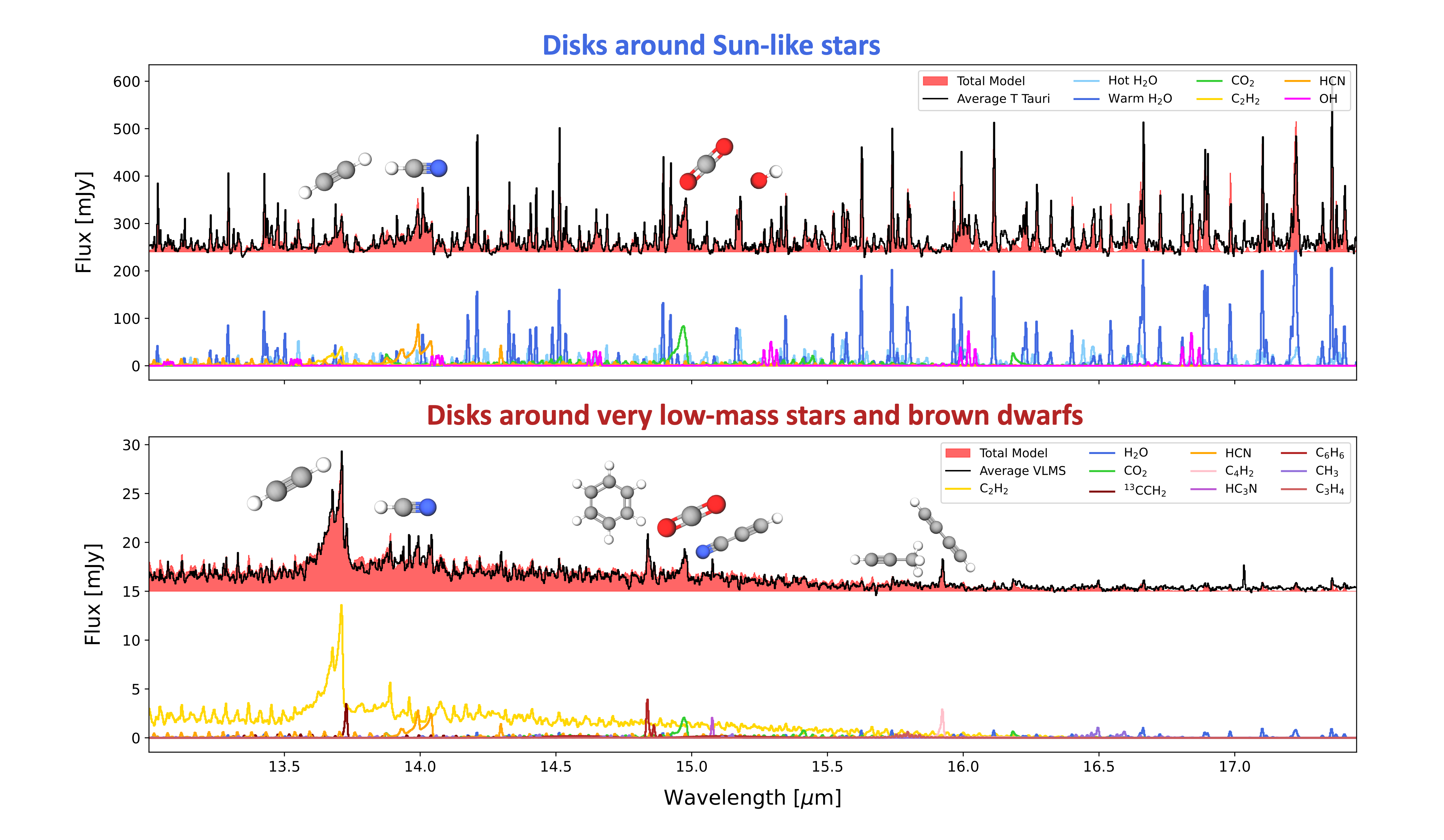
Differences in inner disk chemistry as a function of the mass or brightness of the central star or brown dwarf have been seen since the days of Spitzer (Pascucci et al. 2009, 2013). Early JWST results found that the differences between disks around stars like the Sun and those around objects 1/5th the mass of the Sun were even more different than was previously known (e.g., Tabone et al. 2023, Arabhavi et al. 2024). In Grant et al. (2025), we analyzed the MINDS sample to explore the chemical trends with host mass more generally. We found that with few exceptions, the disks around Sun-like stars are rich in water vapor, while the disks around low-mass stars and brown dwarfs are dominated by acetylene (C2H2) and larger hydrocarbon chains and rings. There is a strong anticorrelation between the flux of C2H2 and H2O as a function of the host brightness (a trend we now know extends down to the planetary-mass regime). We hypothesize that extra carbon is needed in the inner disks of low-mass objects, but we are not yet sure exactly what is producing this hydrocarbon “soup”, but it could be related to the evolution of dust in these disks and the fact that the dust evolution may happen faster around lower-mass hosts. It raises a lot of questions about how planets forming in a disk around a Sun-like star will differ from the many planets we know to exist around small stars. We hope by continuing to investigate the exotic disk chemistry in these small objects, we will be able to find out.
Top: The 13 to 17.5 micron average JWST spectrum of disks around Sun-like stars (top) compared to disks around very low-mass stars and brown dwarfs (bottom). The average observed spectrum is shown in black compared to the total model in red. The molecular components that make up the spectra are shown in the colors below. Adapted from Grant et al. (2025).
The anticorrelation between the flux of acetylene (C2H2) and water (H2O) as a function of the brightness (luminosity) of the star or brown dwarf at the center of the disk. Adapted from Grant et al. (2025).

 sierragrant.com