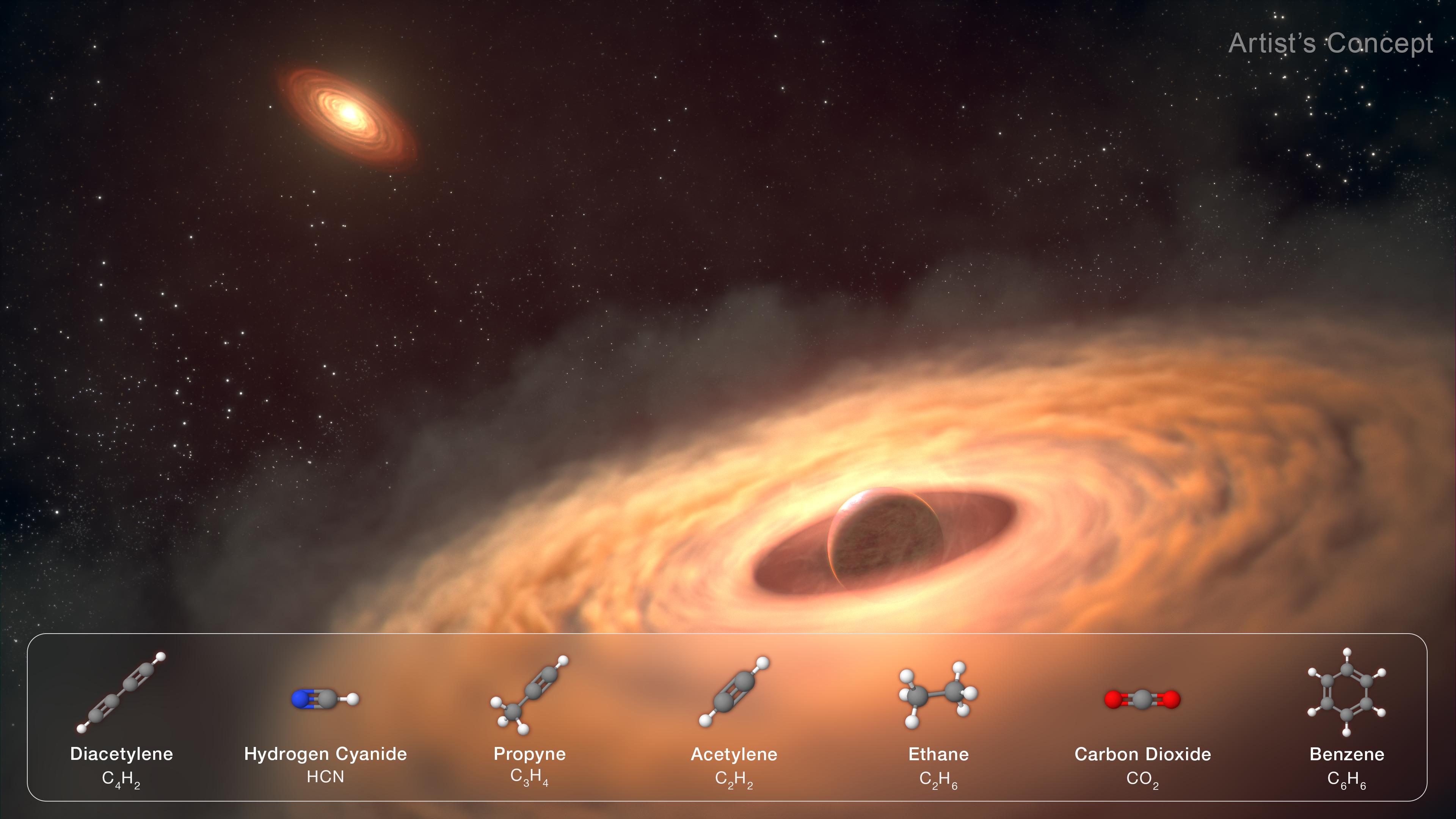
We found that the disk around the companion is extremely carbon-rich, with emission from seven carbon-bearing molecules, including species as complex as benzene (C6H6), and the isotopologue 13CCH2. This carbon-rich chemistry is in stark contrast with the spectrum of the circumstellar disk around the host star, which we show has no emission from carbon-bearing molecules and instead has only oxygen-bearing species. This coeval chemical dichotomy within a single star-plus-companion system provides direct evidence that rapid, divergent chemical evolution occurs on ~Myr timescales. We put the system into context by comparing CT Cha A and b to the largest sample of JWST data on protoplanetary disks compiled thus far, finding that CT Cha A is chemically similar to other Sun-like systems. CT Cha b instead extends previously found chemical correlations down to the planetary-mass regime for the first time.
This result was presented in a number of press releases, including one from NASA.

 sierragrant.com